




Methodology
Background
The historiographical hypothesis underpinning the FILMUSP project—later corroborated by oral testimonies and archival findings—was that in Italy, unlike other national contexts, the music publishing sector played a primary role in financing film soundtracks and profiting from their exploitation across all media platforms: printed scores, records, live performances, and licensing for audiovisual synchronisation (cinema, television, advertising). During the 1970s, this became an increasingly differentiated and profitable field
By identifying publishers as intermediaries between musicians and the film and record industries, FILMUSP investigates the aesthetic, sociocultural, and economic implications of Italian film music from a material history perspective.
Research questions
FILMUSP employs the focus on music publishing as an entry point to examine the broader relational dynamics within film music production. The research revolved around two key questions:
-
How did adjacent industrial and media segments of the Italian entertainment system intertwine around the object of “film music,” which progressively established itself as an autonomous musical and phonographic product between 1958 and 1976?
-
Can the role of individual “actors” (in the Latourian sense) be analysed through the networks they form, depending on the characteristics of different film and music genres, record formats (theme single, soundtrack album, compilation, etc.), and production environments (independent vs. major circuits, international co-productions, etc.)?
Mixed methods
FILMUSP combines two approaches often perceived as divergent: quantitative, data-driven analysis and qualitative, archival research based on case studies. While the latter has traditionally characterised musicological and film studies, the former emerged from the possibility of cross-referencing freely accessible online data sources that had never before been systematically integrated.
At the core of the project lies a relational database that integrates heterogeneous sources—open-access repositories, copyright deposits, and archival documents. It does not function as a digital archive, but rather as an infrastructure for linking and modelling data and metadata derived from artefacts (films, records, soundtracks, compositions), companies (publishers, record labels, film production companies, etc.), individuals (composers, arrangers, musicians, copyists, engineers, film directors, producers, etc.), and sources (archival documents, interviews) that were previously disconnected or only partially related.
Quantitative research
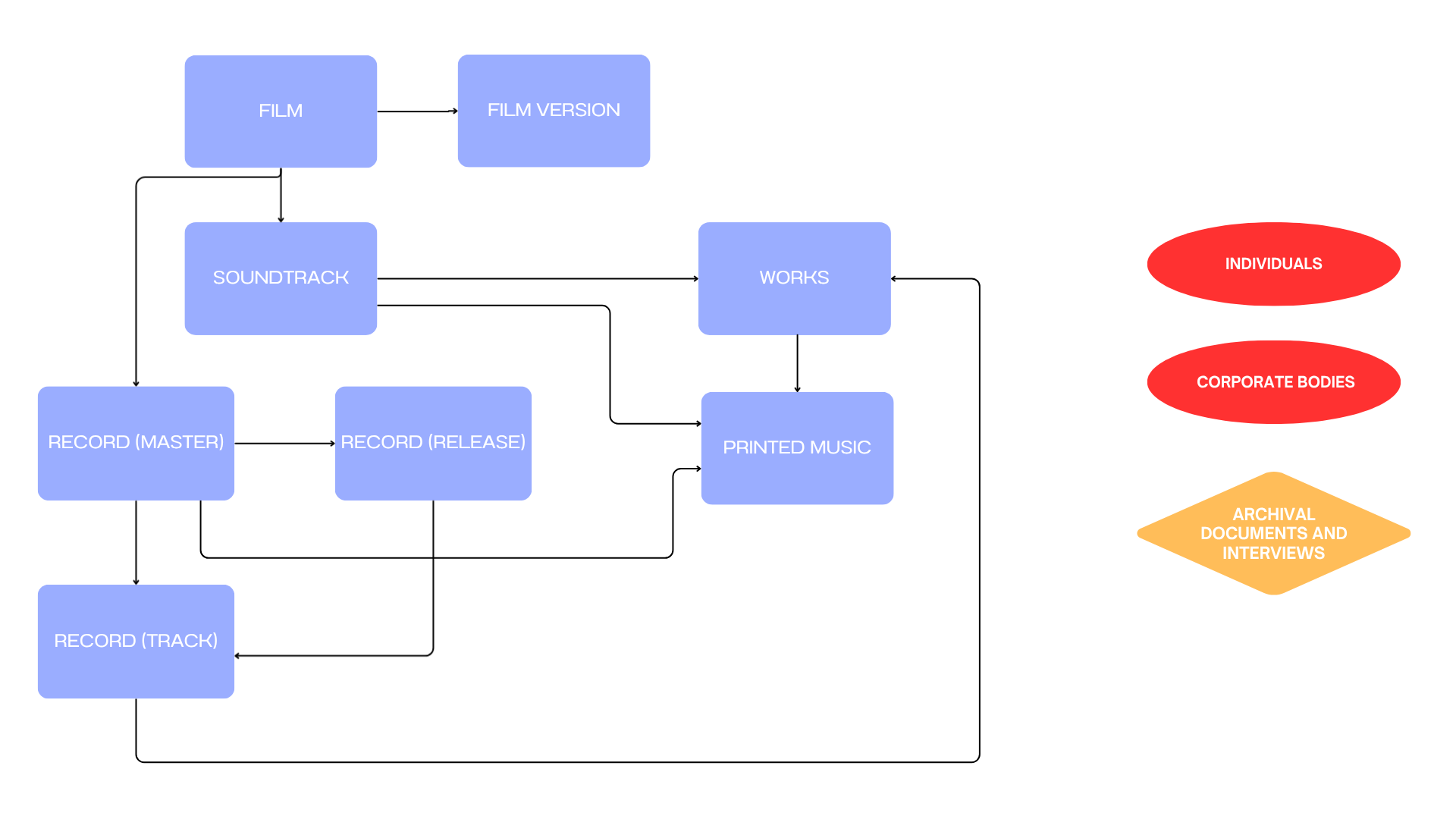
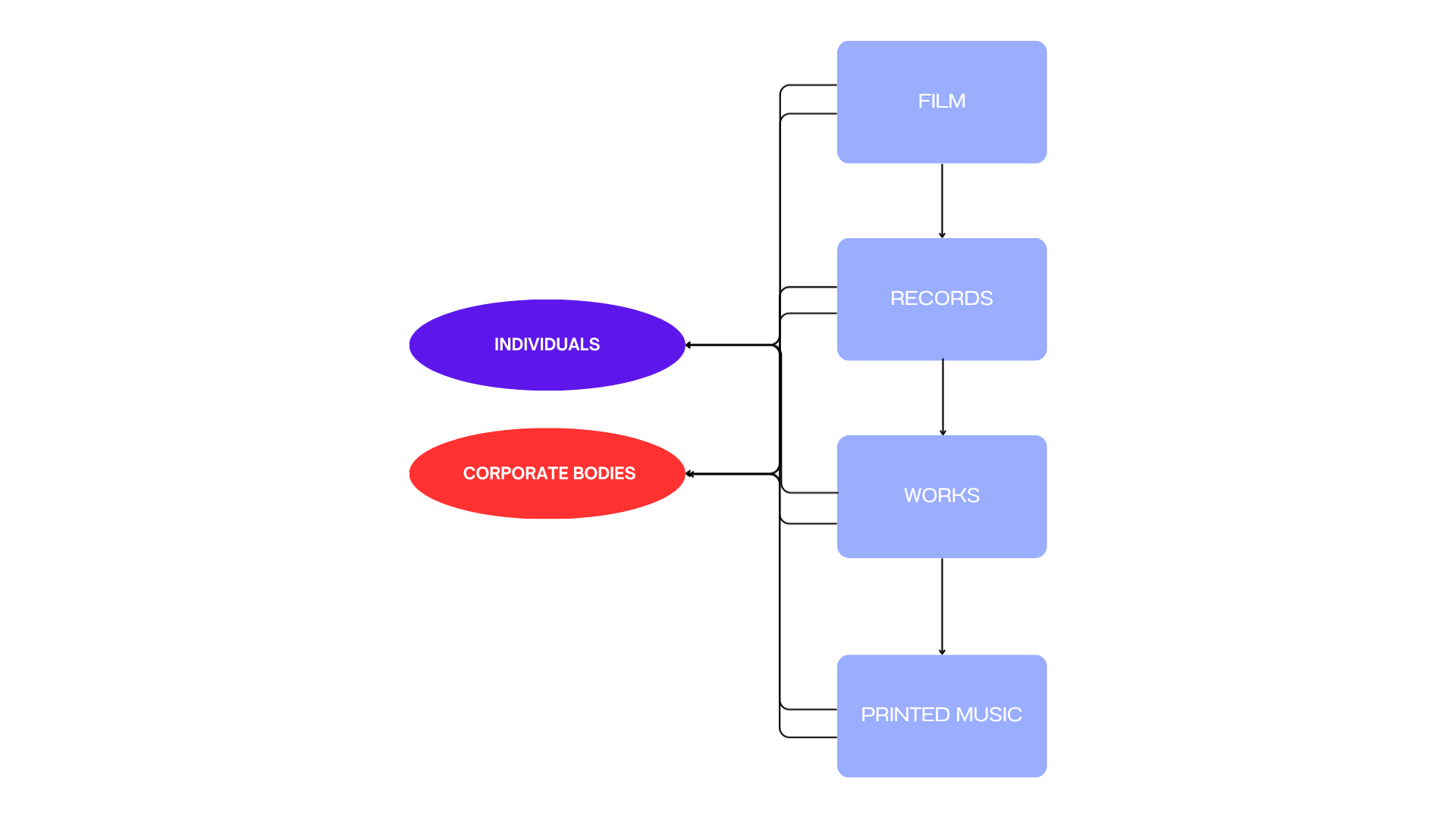
To develop this database, the Milan, Pavia, and Pisa units jointly designed a data model based on a pragmatic adaptation of the WEMI (Work–Expression–Manifestation–Item) bibliographic framework. The resulting model comprises eight interrelated Entities (Films, Film Versions, Soundtracks, Record Masters, Record Releases, Tracks, Musical Works [e.g. Compositions], Printed Music), linked to Responsibilities (Individuals and Corporate Bodies) and Sources (Archival Documents and Interviews).
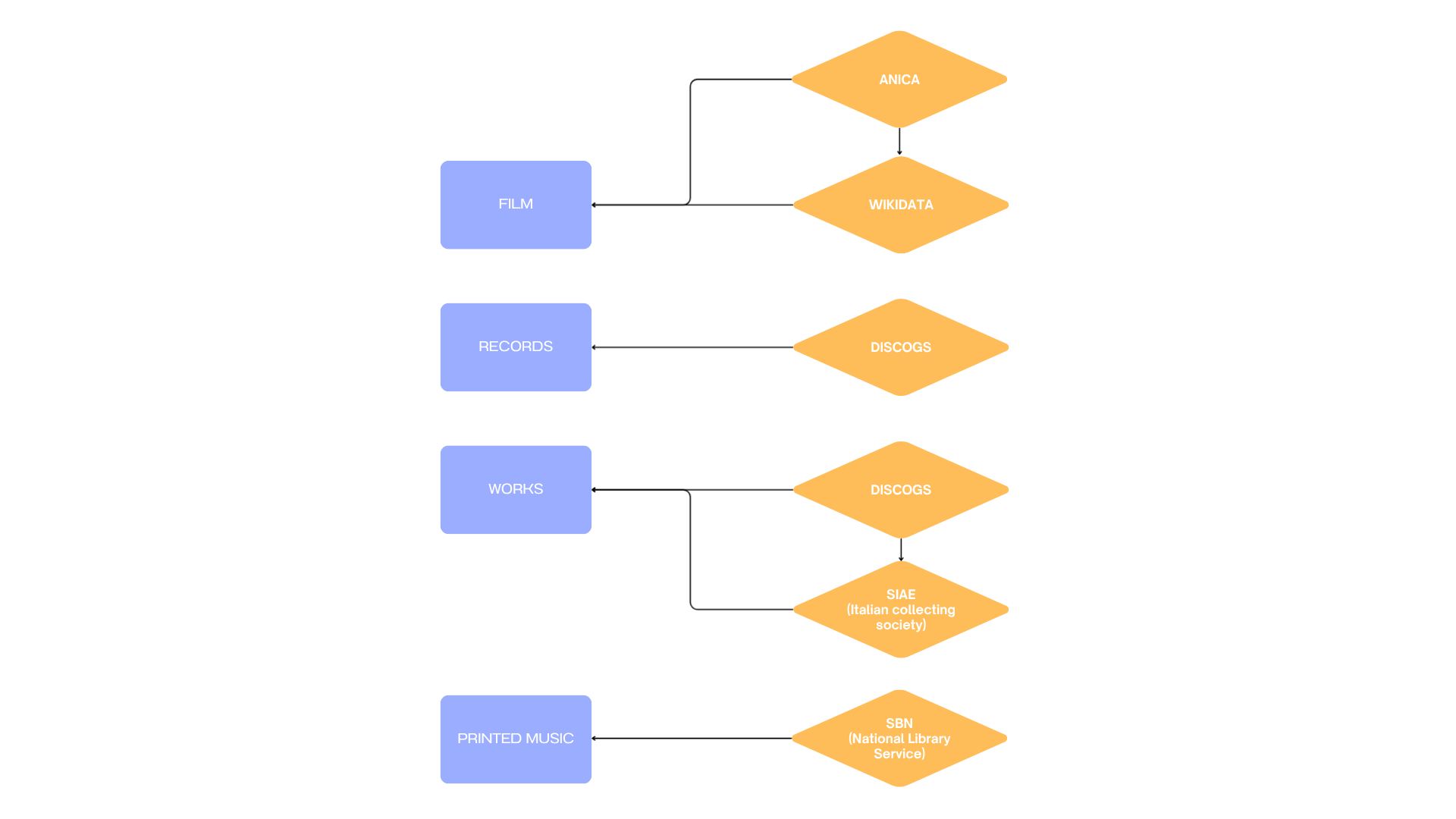
The Pavia unit extracted, filtered, cleaned, and reconciled extensive data on films, soundtracks, and musical works from the following sources:
-
Films: Wikidata and the ANICA Online Film Archive
-
Records: Discogs.com
-
Soundtracks and musical compositions: SIAE Online Archive
-
Printed music: OPAC of the Italian National Library System
These datasets were prepared for import into a xDams back-end developed by regesta.exe, while a synchronised, publicly accessible front-end was designed for both specialists and general users.
The Network Graph
The database enables exploration of interactions among products (films, soundtracks, records, tracks, songs), responsibilities (people, companies), or between products and responsibilities. These interactions can be visualised through social network analysis, facilitating the formulation of historical hypotheses about “common practices” beyond individual case studies—an approach aligned with distant reading.
The Network Graph, developed by the Pavia unit, offers an interactive overview of relational networks and their evolution over time within the project’s chronological scope.
Qualitative research
A key challenge of FILMUSP concerned the integration of digital tools for large-scale data processing with the traditional archival-historical approach. In parallel with database construction, the Bologna, Milan, and Pisa units conducted extensive archival research, examined secondary sources, and collected oral histories.
Archival research went beyond identifying documents for individual case studies: it focused on mapping relationships among agents involved in soundtrack production and highlighting recurring patterns across collections. The work covered archives of institutions, composers, publishers, copyists, producers, and production companies, including:
-
Institutional collections:
-
Files on musical films (musicarelli) in the Archivio Centrale dello Stato, Ministero del Turismo e dello Spettacolo – Direzione Generale Spettacolo (Bologna unit)
-
Minutes of the SIAE Music Section Commission at the SIAE Historical Archive(Milan unit)
-
Paolo Pongolini record collection, Department of Musicology and Cultural Heritage, Università di Pavia (Pavia unit)
-
-
Composers’ collections:
-
Angelo Francesco Lavagnino, Carlo Rustichelli, and Carlo Savina (CSC Foundation – Luigi Chiarini Library; Milan and Pisa units)
-
Vasili Kojucharov and Gino Marinuzzi Jr. (NoMus ETS Archive; Milan and Pavia units)
-
Piero Piccioni’s private archive (Milan unit)
-
Nino Rota and Roman Vlad (Giorgio Cini Foundation; Pisa unit)
-
-
Copyists and publishers:
-
Donato Salone (CSC Foundation – Luigi Chiarini Library; Milan unit)
-
Film synchronisation files (Archivio Storico Ricordi; Milan unit)
-
-
Producers and production companies:
Angelo Rizzoli’s Cineriz collection (CSC Foundation – Luigi Chiarini Library; Milan unit)
The research also included the analysis of historical publications documenting the circulation of artefacts, such as the Annuari dello Spettacolo, Cataloghi Bolaffi del Cinema Italiano (box office data), and Musica e Dischi (charts and release dates), examined by the Bologna unit; as well as the SIAE’s Bollettino and Diritto d’autore (Milan unit).
Finally, interviews were conducted with professionals from the publishing, recording, and film industries, including:
-
Publishing/Recording: Franco Bixio (Bixio/Cinevox), Lula Sarchioni (EMI, Sony Music), Olga Tanferna (CAM) (Milan and Pisa units)
-
Composition/Performance: Pino Donaggio, Marco Testoni, Enrico Pieranunzi (Bologna and Milan units)
-
Production: Renato Marengo (Milan unit)
-
Music management: Tobia Righi (Bologna unit)
The selected documents are currently being metadata-tagged to link them to existing records, thereby validating, correcting, or enriching the data.
Challenges and future prospects
The project faced several challenges, including the complexity of data preparation, the risk of reducing interpretive richness to schematic metadata, and the uneven reception of digital methods within the humanities. However, the interplay between quantitative and qualitative approaches proved fruitful: quantitative analysis not only confirmed insights derived from case studies but also revealed patterns that refined archival findings, while archival research anchored abstract trends in concrete historical evidence.
FILMUSP thus positions itself not merely as a consultable archive but as an open, evolving infrastructure, designed to be expanded by future scholars and research groups. Its speculative, relational database exemplifies the complementarity of distant and close reading. Through the productive tension between “old” and “new” methods, FILMUSP proposes an integrated model that uses digital tools to inform archival research, encourages methodological cross-fertilisation, and enables continuous verification of results. The project ultimately aims to foster new knowledge and provide tools for a richer, multifaceted understanding of film music production in Italy.